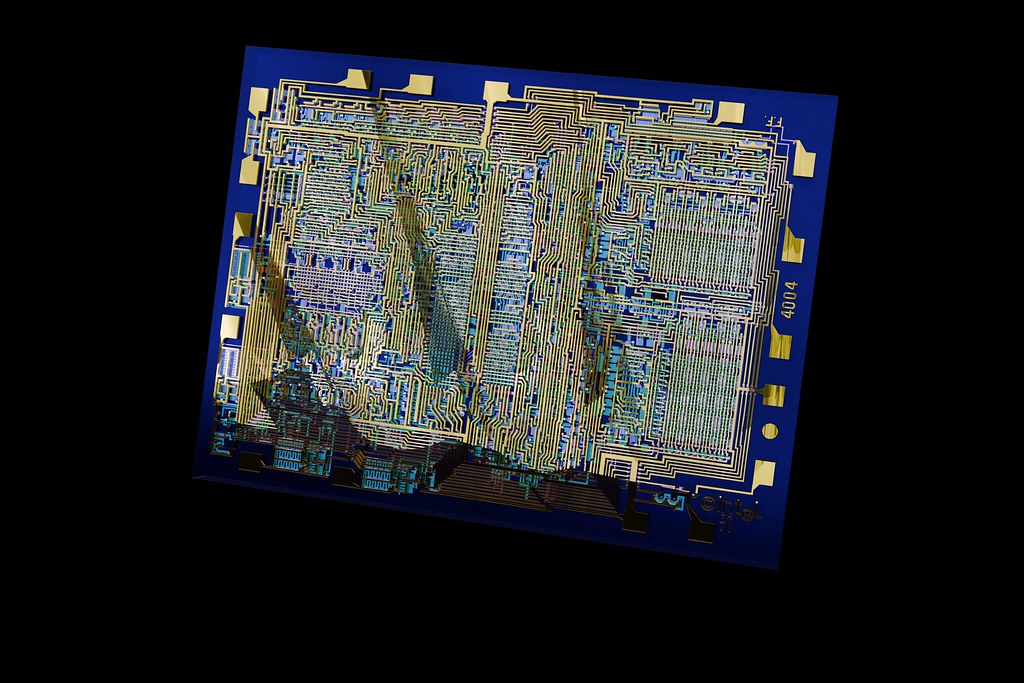
Above: an Intel 4004, the first commercial single-chip microprocessor (photo: Onri Jay Benally, CC BY 2.0). Vacuum tubes made the first electronic computers possible, but they were a nightmare to live with. They were big, hot, power-hungry and they burned out like light bulbs. ENIAC's engineers spent much of their time hunting for dead tubes. For computers to become smaller, cheaper and more reliable, someone needed a better switch. They found it in a lump of germanium.
Bell Labs, from Manhattan to Murray Hill
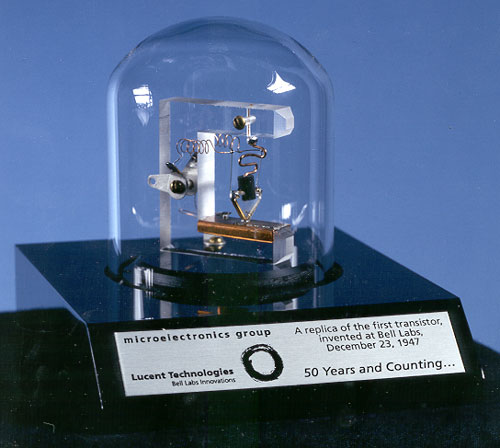
Bell Telephone Laboratories, the research arm of AT&T, was founded in 1925 with its headquarters at 463 West Street in Manhattan's West Village. The building, overlooking the Hudson, is now Westbeth, a home for artists. Bell Labs gradually moved its research to a campus in Murray Hill, New Jersey, and it was there, in December 1947, that physicists John Bardeen and Walter Brattain, working in a group led by William Shockley, built the first working transistor.
It didn't look like much: a sliver of germanium, a plastic wedge wrapped in gold foil, and a spring that looked a bit like a bent paperclip. But it could amplify and switch electrical signals like a vacuum tube, while being far smaller, cooler and potentially more reliable. Shockley soon devised an improved "junction" transistor. The three shared the 1956 Nobel Prize in Physics.
Transistorised computers and magnetic memory
By the late 1950s, computers built with transistors instead of tubes were appearing, among them IBM's 7090 and the UNIVAC LARC. They were faster, smaller and more dependable. Memory improved too. Instead of fragile tubes or mercury delay lines, machines of the 1950s and 60s used magnetic core memory: grids of tiny iron rings threaded with wires, each ring storing one bit by the direction of its magnetism. Core memory was developed for MIT's Whirlwind computer and became the standard for nearly twenty years. It's why some programmers still call memory dumps "core dumps."

The tyranny of numbers, and the chip
Transistors created a new problem. Complex circuits needed thousands of separate transistors, resistors and capacitors, all hand-soldered together. Engineers called it the "tyranny of numbers": more connections meant more failures.
Two people solved it independently. In 1958, Jack Kilby at Texas Instruments built a working circuit with several components on a single piece of germanium. In 1959, Robert Noyce at Fairchild Semiconductor in California patented a way to build a complete circuit on a flat piece of silicon, using the "planar" process developed by his colleague Jean Hoerni, with metal connections laid down on top. Noyce's version could be mass-produced. The integrated circuit, the microchip, was born. Kilby received the Nobel Prize in Physics in 2000; Noyce had died in 1990.
The chip's real genius wasn't miniaturisation. It was that you could print whole circuits instead of wiring them by hand.
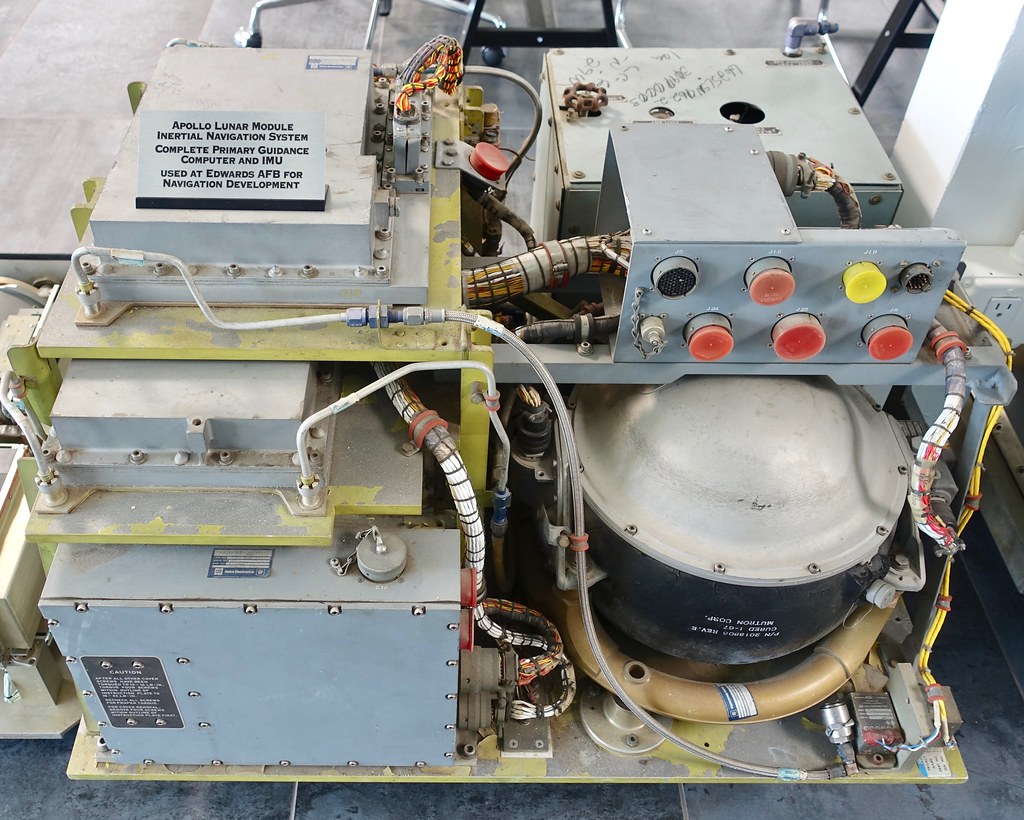
Early chips found eager customers in the military and NASA, including in the Apollo Guidance Computer that helped land astronauts on the Moon in 1969.
Moore's Law
In 1965, Fairchild's research director, Gordon Moore, was asked by Electronics magazine to predict the future of chips. He noticed that the number of components that could be economically placed on a chip had been doubling roughly every year, and predicted the trend would continue for at least a decade. In 1975 he revised the pace to about every two years. "Moore's Law" wasn't a law of nature, more a self-fulfilling roadmap that the industry raced to keep up with for half a century. See it in action in our Moore's Law Machine.
A computer on a fingernail
In 1968, Noyce and Moore left Fairchild to found Intel. In 1969, a Japanese calculator company, Busicom, asked Intel to design a set of chips for a new line of calculators. Intel engineers Ted Hoff, Stan Mazor and Federico Faggin, working with Busicom's Masatoshi Shima, came up with a radical design: instead of a dozen custom chips, a single general-purpose processor chip that could be programmed to run the calculator.
The result was the Intel 4004, launched in November 1971. It held about 2,300 transistors, ran at 740 kilohertz and processed data four bits at a time. It had roughly the computing power of ENIAC, on a chip a few millimetres across. Intel negotiated back the rights to sell it to other customers, and advertised it as "a new era of integrated electronics." It was right. The microprocessor made it possible to put a computer into almost anything, and soon onto every desk, which is where our final entry picks up.