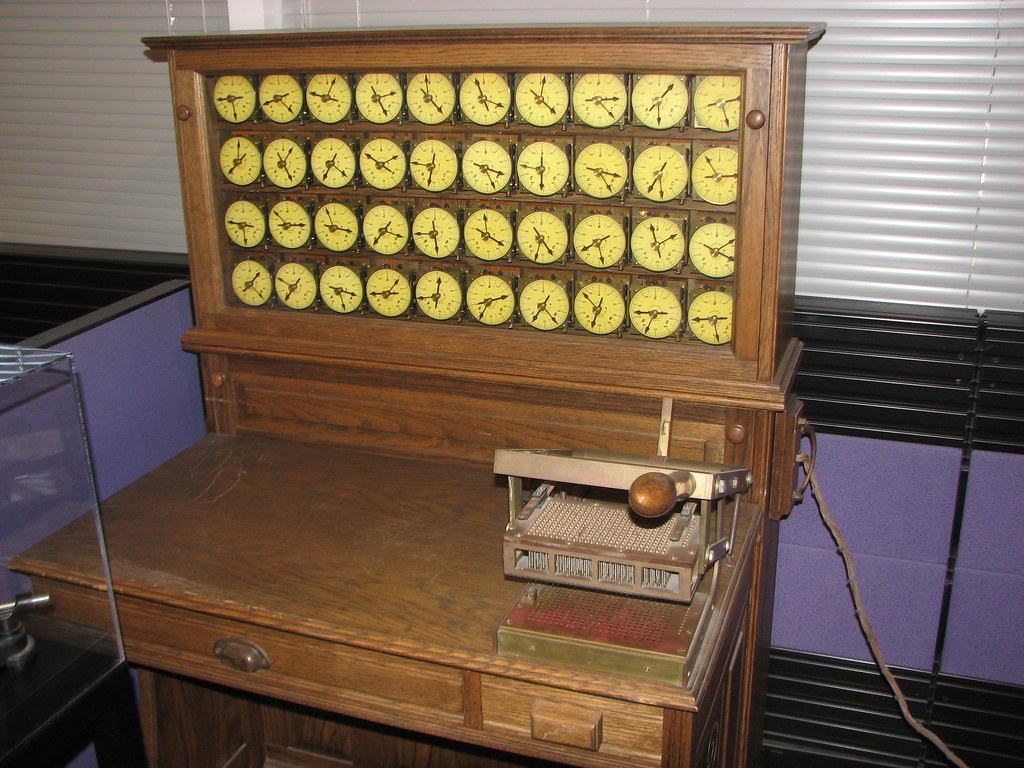
Above: a Hollerith census tabulator on display (photo: Erik Pitti, CC BY 2.0). Every ten years, the US Constitution requires a count of everyone in the country. In 1880, that count was done mostly by hand: clerks read census schedules and made tally marks, column after column. The population was growing so fast that processing the 1880 results took most of a decade. Officials worried that the 1890 census might not be finished before the 1900 one began. Into this crisis stepped a young engineer with an idea borrowed, he later said, from a train conductor.
A ticket punch and a big idea
Herman Hollerith was born in Buffalo, New York, in 1860 to German immigrant parents. He graduated from the Columbia School of Mines in Manhattan in 1879 and went to work for the Census Office, where he saw the counting problem firsthand. He noticed how railway conductors punched tickets to record a passenger's description, a kind of "punch photograph." Why not record each person in the census the same way, as holes in a card, and let a machine count them?
Hollerith designed a system with three parts:
- a punch, used by clerks to make holes in a card for each person's characteristics: age, sex, race, birthplace, occupation and so on;
- a tabulator, where a clerk placed each card in a press. Spring-loaded pins came down; wherever there was a hole, a pin passed through into a tiny cup of mercury, completing an electrical circuit that advanced a counting dial by one;
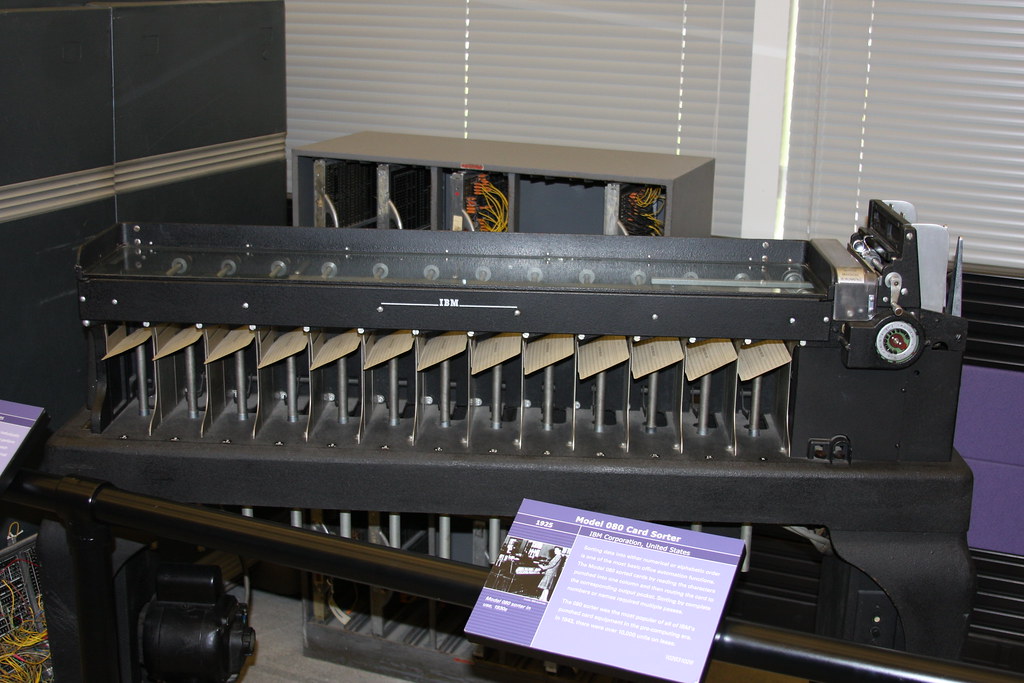
- a sorter, a box with lids that popped open electrically to show the clerk which compartment the card belonged in.
Electricity, not gears, did the counting. That's the step from mechanical to electric data processing.
The 1890 census
Hollerith's machines won a competition against rival systems and were used for the 1890 census. The results were dramatic. A preliminary population count was announced within weeks rather than years, and the full tabulation, far more detailed than before, was completed in a fraction of the previous time. The Census Office estimated savings of years of work and millions of dollars. Columbia awarded Hollerith a doctorate for the work in 1890.
Clerks reported that operating the machines was exhausting and repetitive in a new way, and some remembered the dial bells ringing all day. The world of data processing had arrived, along with its first office headaches.

From Tabulating Machine Company to IBM
Hollerith's machines were soon counting censuses in Austria, Canada, Norway and Russia, and railroads and insurance companies wanted them for accounting. In 1896 he founded the Tabulating Machine Company. In 1911, the financier Charles Flint merged it with three other firms making scales, time clocks and slicers, forming the Computing-Tabulating-Recording Company (CTR), incorporated in New York.
In 1914, CTR hired a salesman named Thomas J. Watson Sr., who had been forced out of the National Cash Register Company. Watson was a showman and a disciplinarian. He introduced the company motto "THINK," dress codes, company songs and an obsession with sales. In 1924 he renamed CTR International Business Machines. IBM grew into one of the most powerful companies in the world, and it is still headquartered in New York State, in Armonk, Westchester County.
The card that ran the world
In 1928, IBM introduced its 80-column punched card with rectangular holes, which held more information than Hollerith's round-hole cards. It became an industry standard for half a century. Punched cards processed payrolls, inventories, bank statements and university exam results. When the US Social Security system launched in the 1930s, IBM machines handled the records for millions of workers. Computer programmers in the 1960s and 70s carried boxes of cards with their programs on them. Dropping a box of unnumbered cards was a programmer's nightmare.
Cards often carried the warning "Do not fold, spindle or mutilate," a phrase that became a slogan of 1960s protest against the impersonal machinery of modern bureaucracy.
Why it matters
Hollerith didn't build a computer. His machines couldn't be programmed in Babbage's sense. But he proved that machines could handle huge amounts of information quickly and reliably, and he built the industry, and the company, that would carry punched cards straight into the electronic age. The giant machines of the 1940s, in our next entry, would read their data from punched cards too.