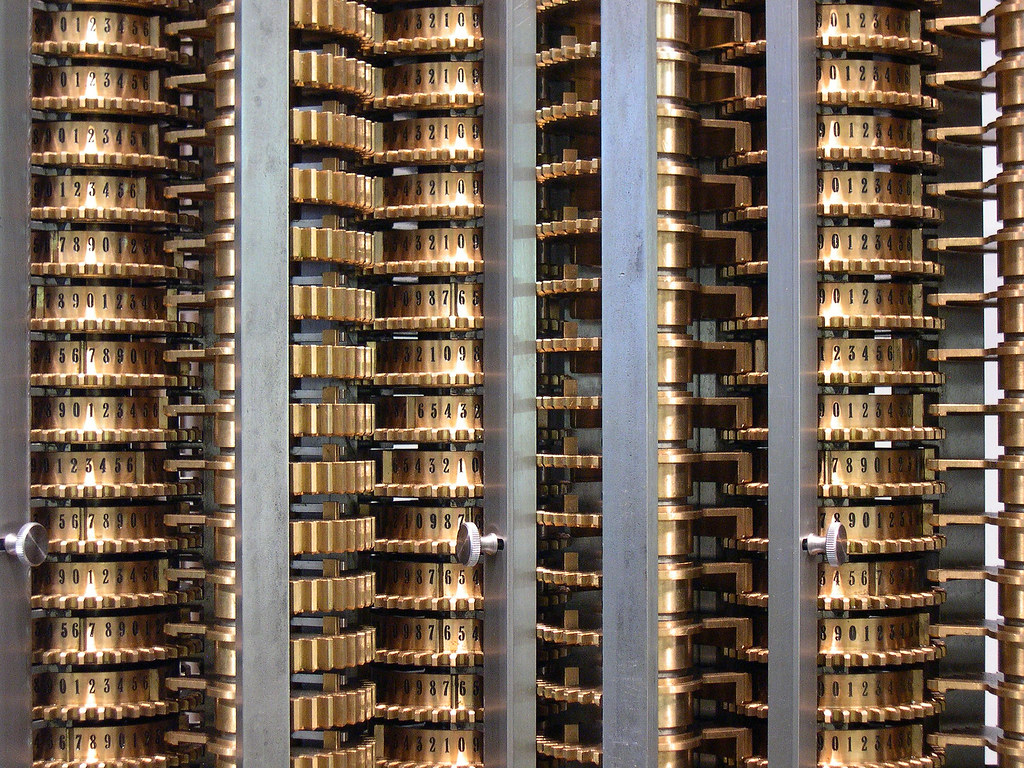
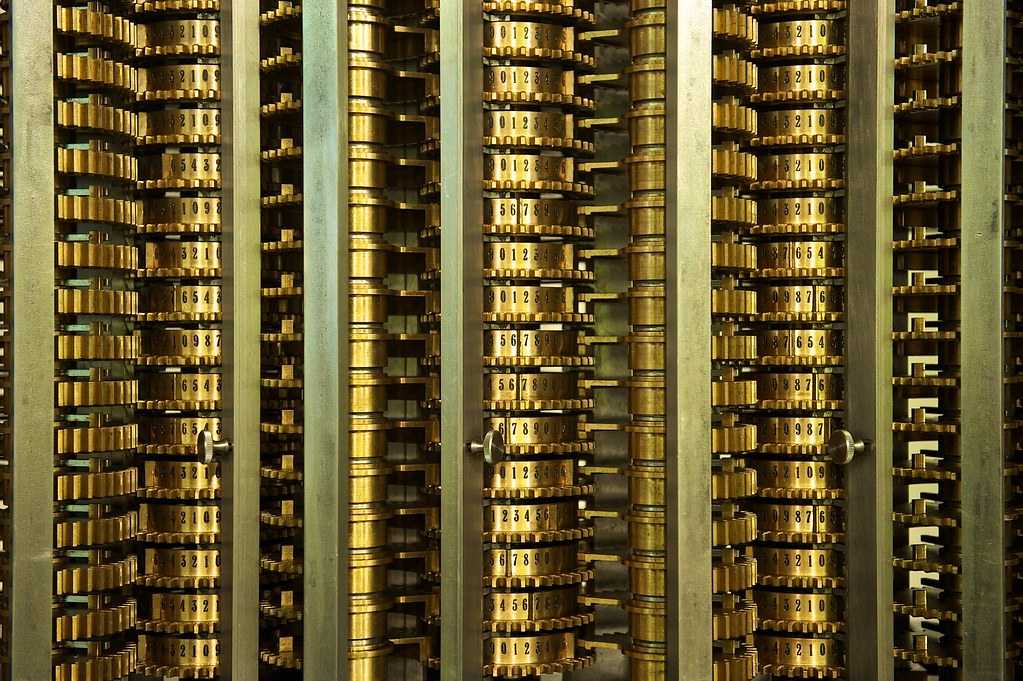
Above: Babbage's Difference Engine No. 2, built from his original drawings (photo: ullrich.c, CC BY-SA 2.0). Charles Babbage was, by most accounts, a difficult man. He waged a long public war against London's street musicians, whose noise he claimed ruined his concentration. He quarrelled with engineers, politicians and fellow scientists. He also designed, in the 1830s, a machine with almost every essential feature of a modern computer, a hundred years before anyone built one. To understand how, we have to start in a silk mill in France.
A loom that read cards
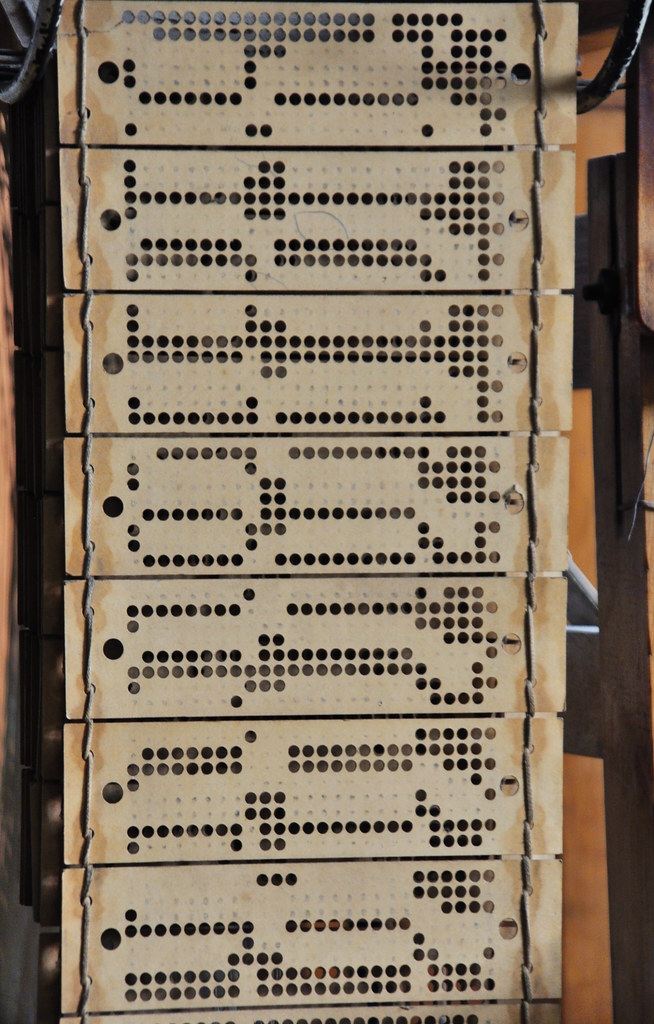
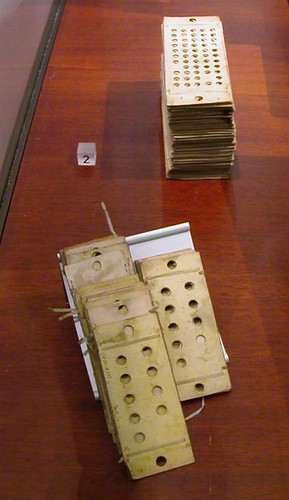
Weaving complex patterns like brocade used to require a "draw boy" who sat on top of the loom lifting the right threads by hand for every row. Around 1804, the French weaver Joseph-Marie Jacquard perfected a loom attachment that did the job automatically. A chain of stiff cards, each punched with holes, passed through the loom. Where there was a hole, a hook could pass through and lift a thread; where there wasn't, it couldn't. Change the cards, and you changed the pattern.
This was a profound idea: a machine whose behaviour was controlled by an external, replaceable set of instructions stored as holes in cards. In other words, a program. Babbage owned a famous woven silk portrait of Jacquard, made using thousands of cards, and liked to show it to visitors, asking them to guess how it was made.
The Difference Engine
In the early nineteenth century, navigators, engineers and bankers relied on printed tables of numbers: logarithms, tides, interest rates. These were calculated by human computers and were full of errors, and an error in a navigation table could sink a ship. Babbage set out to make a machine that would calculate and print tables automatically, using a mathematical technique called the method of differences.
He began building his Difference Engine in 1822 with funding from the British government. It required thousands of precisely made parts, pushing the limits of Victorian engineering. Costs ballooned, Babbage fell out with his chief engineer, and the work stopped in the early 1830s with only a small demonstration section complete.
Babbage's problem wasn't that his ideas were wrong. It was that the world couldn't yet make them.
The Analytical Engine: a real computer, on paper
By then, Babbage had moved on to something far more ambitious. From 1834 he designed the Analytical Engine, a general-purpose machine. Its design included:
- a "store" to hold numbers, which we'd now call memory;
- a "mill" to do arithmetic, essentially a processor;
- input through punched cards, borrowed from Jacquard, for both data and instructions;
- the ability to make decisions, jumping to different instructions depending on results (what programmers call conditional branching) and repeating sequences (loops);
- output to a printer, and even a curve plotter.
It would have been driven by steam, roughly the size of a small locomotive. Babbage worked on the designs for the rest of his life, but the Analytical Engine was never built.
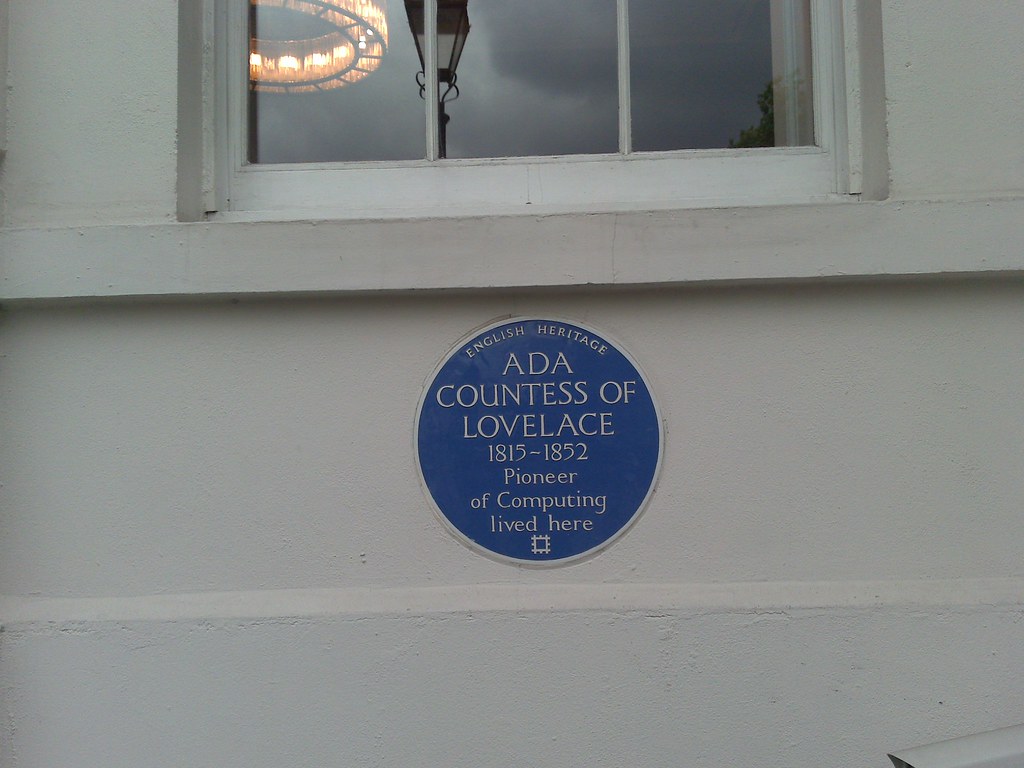
Ada Lovelace and Note G
Augusta Ada King, Countess of Lovelace, was the daughter of the poet Lord Byron, though she never knew him. Her mother insisted on a rigorous education in mathematics, partly to steer her away from her father's "poetic" temperament. Ada met Babbage as a teenager in 1833 and became fascinated by his machines.
In 1842, an Italian engineer, Luigi Menabrea, published a paper in French describing the Analytical Engine. Lovelace translated it into English and added her own "Notes," which ended up roughly three times longer than the original article. Published in 1843, they include Note G, a detailed, step-by-step method for the Engine to calculate a sequence called the Bernoulli numbers. It's widely considered the first published computer program.
Historians debate how much of the mathematics was Lovelace's and how much came from Babbage. What is clearly hers is the vision. She suggested the Engine could work with symbols, not just numbers, and might one day compose music if the rules of harmony were expressed in its notation. She also cautioned that it could only do what it was instructed to do and could not originate anything, a line still quoted in debates about artificial intelligence.
Built at last
Babbage also designed an improved Difference Engine No. 2 in the late 1840s. In 1991, for the bicentenary of his birth, the Science Museum in London completed the calculating section from his original drawings, using only tolerances achievable in his day. It worked. The printer was added in 2000. The machine has about 8,000 parts and weighs around five tonnes. A second copy was built for display at the Computer History Museum in California. Babbage, it turned out, had been right all along.
Punched cards, meanwhile, were about to get a much more down-to-earth job: counting the people of the United States. That's next.