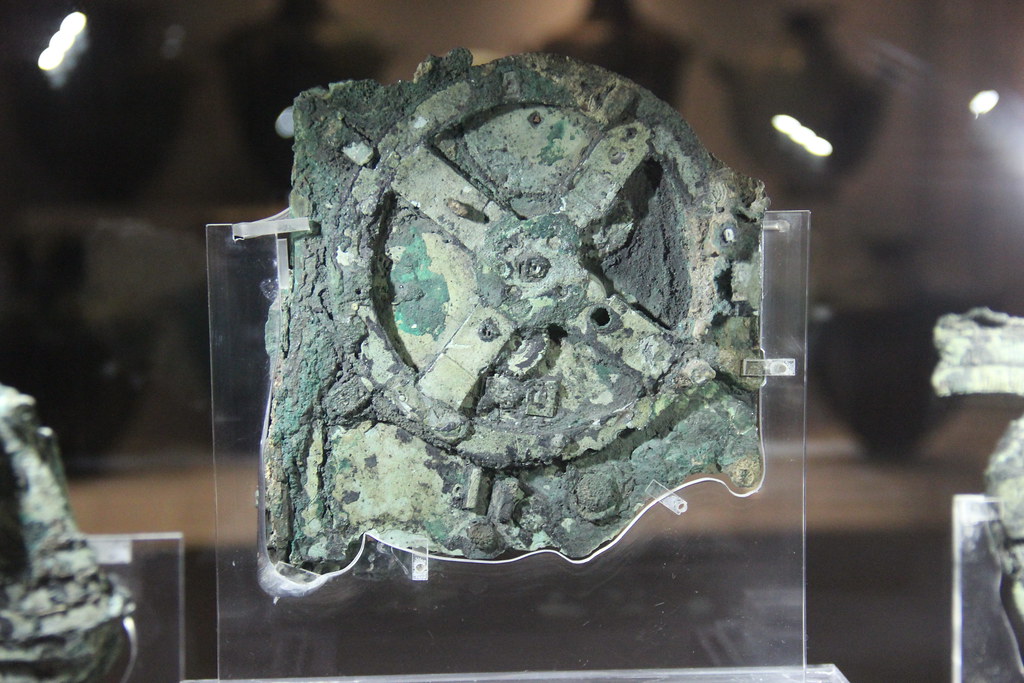
Above: fragments of the Antikythera mechanism (photo: Gary Lee Todd, CC0). Long before anyone plugged anything in, people were building machines to help them think. The word "computer" itself originally meant a person, someone whose job was to compute, often by hand, for hours on end. The story of computing machines begins with the tools those people used to make their work faster and less error-prone, and some of those tools are astonishingly old.
Pebbles, lines and beads
Our word "calculate" comes from the Latin calculus, a small pebble. Merchants and officials in the ancient world moved pebbles across lines drawn in sand or on a board to keep track of numbers. Over time these counting boards became the abacus: beads sliding on rods in a frame. Versions appeared in Mesopotamia, Greece, Rome, China and Japan. The Chinese suanpan and the Japanese soroban are still taught today, and a skilled user can add and subtract faster than most people can type numbers into a calculator.
The abacus isn't a machine in the modern sense, since the person does all the logic. But it introduced a powerful idea: representing numbers with physical positions that you can manipulate according to rules.
A computer from a shipwreck
In 1900, sponge divers sheltering from a storm near the Greek island of Antikythera discovered a Roman-era shipwreck loaded with statues, pottery and coins. Among the finds brought up the following year was a lump of corroded bronze and wood. Months later, it split open to reveal something no one expected from the ancient world: precisely cut gear wheels.
The Antikythera mechanism, usually dated to somewhere around 150–100 BCE (some researchers argue earlier), is now in the National Archaeological Museum in Athens. Decades of study, from Derek de Solla Price's work in the 1950s and 70s to high-resolution X-ray CT scans in the 2000s, revealed what it did. Turning a handle drove a train of around thirty surviving bronze gears that modelled the movements of the Sun and Moon, predicted eclipses, tracked the phases of the Moon and even the four-year cycle of the ancient Olympic Games.
Nothing as mechanically complex as the Antikythera mechanism is known again for more than a thousand years.
It's best described as an analog computer: it modelled the sky with gear ratios rather than calculating with digits. But the craftsmanship is extraordinary, and it's a humbling reminder that ancient engineers were capable of far more than we often assume.
Napier's bones and the slide rule
In the early 1600s the Scottish mathematician John Napier published his invention of logarithms, which turn multiplication into addition. He also devised a set of numbered rods, nicknamed "Napier's bones," that made multiplication easier. Within a few years, the English clergyman William Oughtred built on logarithms to create the slide rule, two sliding scales that let users multiply and divide by lining up marks.
The slide rule had an astonishingly long career. Engineers used it to design bridges, ships, skyscrapers and aircraft for more than three centuries. NASA engineers in the 1960s still carried them. Pocket electronic calculators only made them obsolete in the 1970s.
Pascal's machine
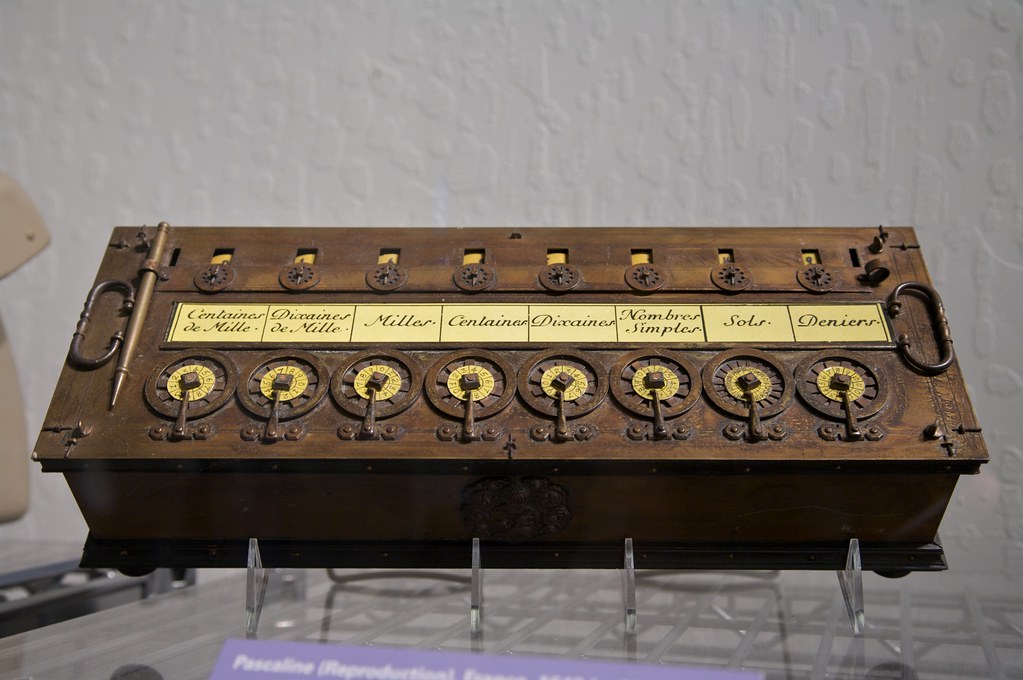
In 1642, a nineteen-year-old in Rouen, France, watched his father, a royal tax official, grind through endless sums. The young man was Blaise Pascal, later famous as a mathematician and philosopher. To help, he designed a brass box with numbered wheels: turn the wheels to enter numbers, and a clever mechanism carried the "one" automatically from one wheel to the next. It became known as the Pascaline.
Pascal built around fifty prototypes over the following decade and about twenty finished machines, a few of which survive in museums. They were expensive and delicate, and they were never a commercial success. But the automatic carry was a genuine breakthrough. For the first time, a machine handled part of the logic of arithmetic itself.
Leibniz: steps and binary
The German polymath Gottfried Wilhelm Leibniz took the next step. In the 1670s he designed a machine called the stepped reckoner, using a cylinder with teeth of varying lengths, the "Leibniz wheel," that could multiply and divide as well as add. The design was so good that versions of it were used in mechanical calculators into the twentieth century.
Leibniz also wrote about something that would become fundamental to modern computers: binary arithmetic, counting with only 0 and 1. In a paper published in 1703 he explained how any number could be written this way, and he was fascinated by its elegance. He didn't build a binary machine, but he planted the seed. Every digital computer today, from your phone to the largest supercomputer, works in Leibniz's ones and zeros. Try it yourself with our Bit Flipper.
The arithmometer: calculators go to work
The first commercially successful mechanical calculator came from France too. In 1820, Charles Xavier Thomas de Colmar patented the arithmometer, based on Leibniz's stepped drum. From the 1850s it was manufactured in quantity and sold to insurance companies, banks and government offices. Mechanical calculating machines like it filled offices for over a century, until electronics swept them away.
All of these machines could calculate. None of them could follow a program, a list of instructions that changes what the machine does. That leap belongs to a weaving loom and a stubborn Englishman, in our next entry.